
Introduction
Most folks believe an advanced SEO audit is only about fixing broken links, adding keywords, and checking page speed. That’s only the surface. A real audit digs in. It exposes hidden problems that gradually undermine rankings without any clear warning signs. Some issues stay dormant for months while traffic keeps dropping little by little.
That’s why smart site owners don’t rely on basic reports. They search for patterns, behaviors, and technical signals that normal tools tend to miss. And this is where an advanced SEO audit becomes important.
Search engines have evolved a lot over the years. The simple tricks don’t work the same anymore. It’s clear that Google cares a lot about user experience, trust signals, topical relevance, and site quality. Old audit methods, because of these changes, leave gaps behind.
The good thing is that these hidden secrets of an advanced SEO audit are not difficult once somebody explains them properly. Smart checks can find some of the problems that stop a site from growing. Some of these problems seem minor but have serious consequences on rankings.
In this guide I’m going to share with you 7 advanced SEO audit secrets that most experts don’t talk about much. All are based on actual experience and common observation. These are not flashy tactics. These are quiet fixes that often yield strong results over time.
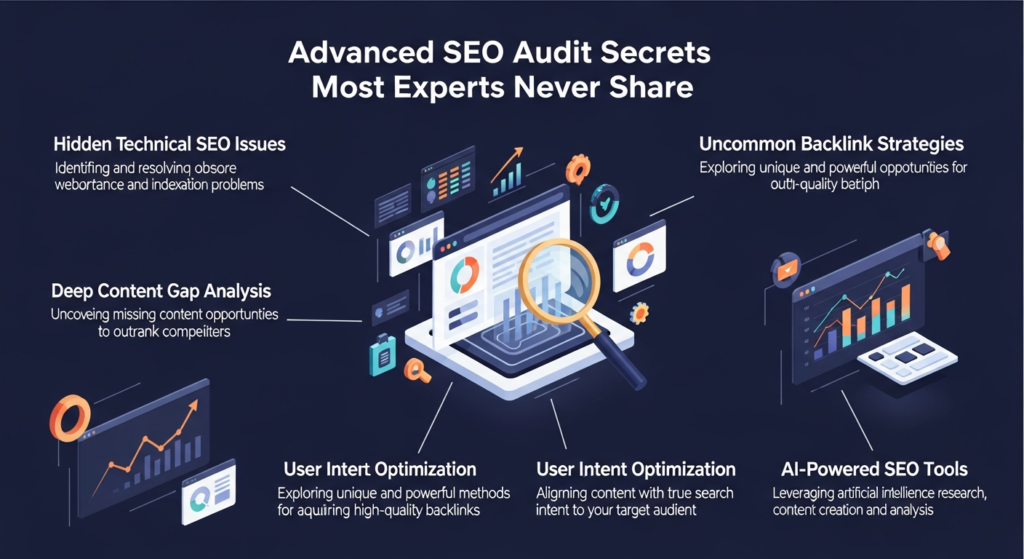
Hidden Crawl Budget Waste Can Harm Rankings
Most site owners don’t think about crawl budget during an advanced SEO audit. They assume search engines will crawl every page perfectly. But this is not always so.
Google cares about the quality and structure of the site. If a site has thousands of useless URLs, search engines spend time crawling those pages instead of important ones.
It typically happens on e-commerce sites, blogs with tag pages, or websites with ineffective filter systems. One product can result in dozens of duplicate URLs. Search engines keep returning to them again and again.
As a result, new pages are indexed slowly. Significant changes could also take longer to appear in search results.
A proper advanced SEO audit is based on server logs instead of the usual crawling tools. Server logs can tell you precisely what search engine bots are visiting most often. This shows that standard audits do not pick up wasted crawling activity at all.
By blocking or cleaning up useless pages, search engines can focus better on the valuable content. Thereafter, rankings often improve naturally as indexing becomes more efficient.
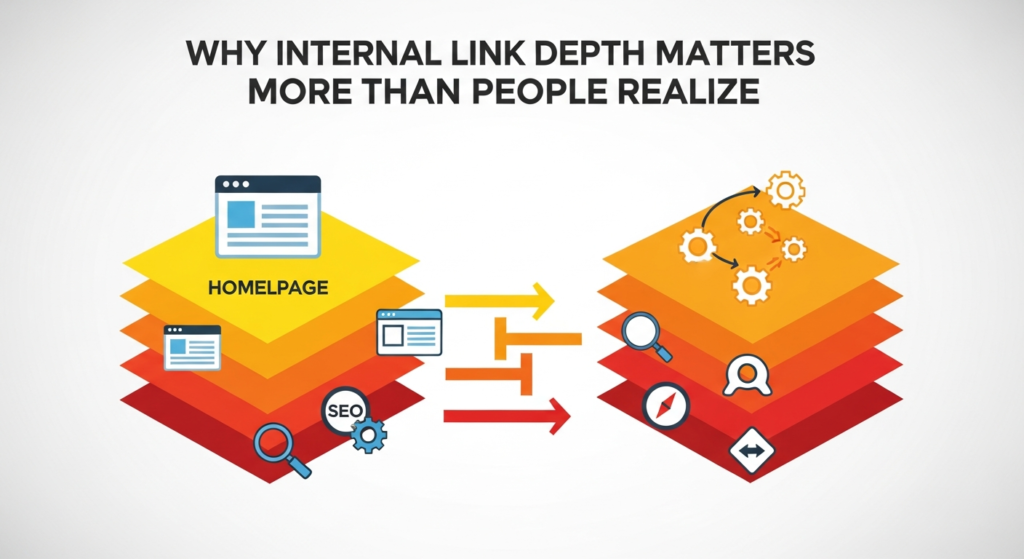
Why Internal Link Depth Matters More Than People Realize
Some pages are indexed but rank poorly. One major factor is poor internal link depth.
Search engines will see a page as less important if you have to click five or six times to get to it from the home page. It is also hard for users to find.
This is a common problem for big blogs. Newer posts slowly bury old articles. Internal links get worse over time, and even excellent content becomes less visible.
A thorough SEO audit will look closely at click depth. Important pages should be as close to the main structure as possible.
Simple contextual links in related articles help a lot. Updating older posts with fresh internal links also helps.
This enhances the topical relationships across the site. Search engines have a better grasp on content relationships, and visitors stay longer because navigation feels natural.
A good internal linking strategy also helps distribute authority evenly across the website. That increases ranking potential without building new backlinks.
Orphan pages kill organic growth silently
Orphan pages are those pages that have no internal links pointing to them. They are on the site, but not linked to the rest of the structure.
This phenomenon is more common than you might think.
Occasionally these pages are from old campaigns, deleted categories, or lost blog posts. In other cases, developers publish pages that they never properly add to the navigation.
These pages are difficult for search engines to find on a regular basis. Even when indexed, they generally receive very little authority.
An advanced SEO audit will cross-reference XML sitemaps with crawl data to identify orphan pages. This process uncovers hidden content that regular audits do not find.
Some orphan pages should be deleted. Others should be more integrated in the site structure.
Fixing orphan pages helps crawl flow and bolsters overall topical coverage. It also prevents valuable content from disappearing into the ether.
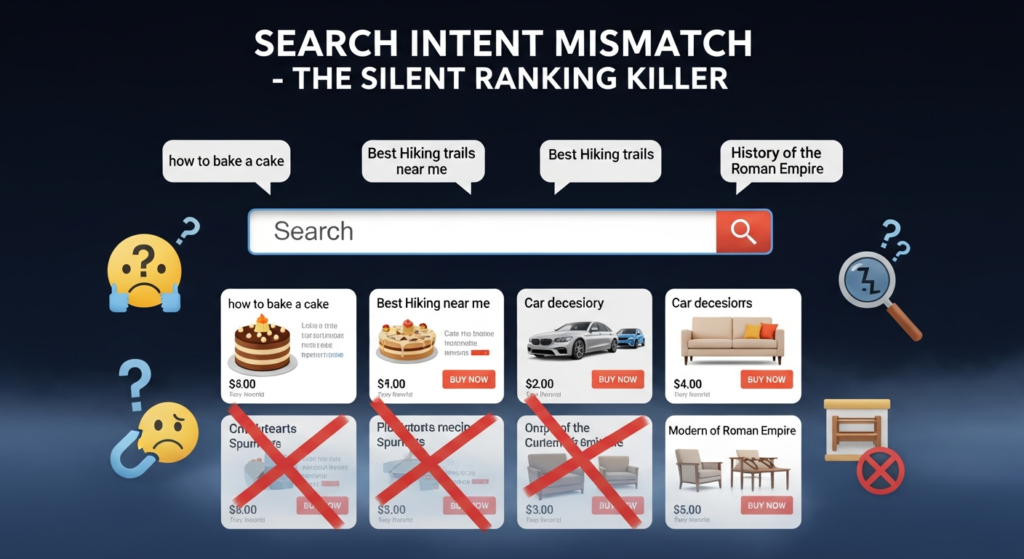
Search Intent Mismatch – The Silent Ranking Killer
You can have good keywords, good backlinks, and good technical SEO and still fail. The problem is usually search intent.
Google knows what people want—really want. If the content does not meet that expectation, rankings will eventually fall.
Someone searching for “best gaming laptops,” for instance, generally expects comparisons and recommendations. If the page only discusses the technical history of a laptop, users don’t stay long.
An SEO audit will take a hard look at what’s currently ranking and then look at the quality of the pages. The question is what makes top-ranking pages successful.
Occasionally the problem is the content format; sometimes it is trust, depth, or freshness.
Small intent mismatches lead to huge ranking gaps.
“Updating content based on real user expectation often works faster than adding extra keywords to improve performance.” This is one of the most underrated SEO audit secrets because it focuses on behavior, not technical scores.
Weak Topical Clusters Reduce Authority
Single articles rarely dominate competitive search results anymore. Search engines prefer websites that show deep topical understanding.
That means content should support related subtopics naturally.
A site about fitness cannot rely on one article about weight loss and expect strong authority. It needs supporting content about nutrition, workouts, recovery, motivation, meal planning, and common mistakes.
An advanced SEO audit studies topical gaps instead of focusing only on individual pages.
This process uncovers missing supporting content that competitors already cover.
Strong topical clusters help search engines trust the site more. They also improve internal linking opportunities and user engagement.
One useful method is reviewing competitor content maps. This reveals missing areas that deserve attention.
Adding connected articles gradually strengthens topical authority. Over time, rankings become more stable because the site looks complete rather than shallow.
Poorly indexed pages can drag down entire sites
A single weak page doesn’t usually kill rankings. There can be hundreds of weak pages.
Search engines look at the overall quality of a site, not just single URLs.
Thin pages, stale content, duplicate articles, and low-value archives slowly erode trust signals. The reason many sites lose traffic is that their indexed page count increases dramatically.
A good SEO audit is a thorough check of the index quality ratio.
This process translates to looking at how many indexed pages actually deserve search visibility.
Some pages need to be merged. Others should be deleted altogether. Some pages can skip index tags if they provide little search value.
Often cleaning low-quality pages improves the overall strength of the ranking, as the search engines focus on the stronger parts of the website.
This process also simultaneously improves crawl efficiency and user experience.
Usually a smaller, high-quality index will work better than a huge, messy one.
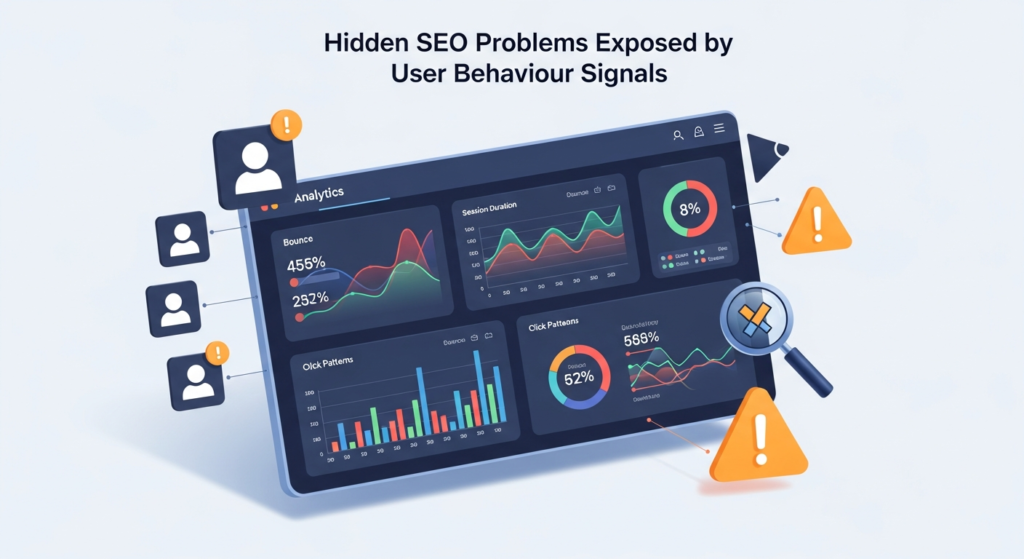
Hidden SEO Problems Exposed by User Behaviour Signals
Most SEO audits don’t consider real user behavior. That’s not right.
The search engines are genuinely interested in how users interact with pages. If visitors bounce quickly or stop interacting, rankings tend to decline over time.
Analytics data, when studied properly, tells powerful stories.
A sophisticated SEO audit looks for trends like sudden exit spikes, low engagement time, and weak interaction flow.
Occasionally the problem is lack of legibility. Occasionally it’s popups that are just too much, a slow mobile layout or bad introductions.
Even the structure of the content heavily impacts user behavior.
Big blocks of text are difficult to read. Confusing layouts make you frustrated. Weak introductions don’t hook the reader.
Improving user experience usually improves SEO naturally because search engines want happy visitors.
Small changes can make a big difference. Improved formatting, more compelling intros, and quicker-loading pages can drive engagement without changing the subject matter.
Closing Remarks
Most SEO audits focus on the obvious because those checks are easy to automate. The hidden weaknesses that standard reports miss reveal real growth.
This is why advanced SEO audits are important.
They reveal structural problems, crawl inefficiencies, poor topic coverage, and user experience problems that silently limit rankings.
What’s particularly compelling is that small wins in these areas tend to produce better results than chasing backlinks or stuffing your content with keywords.
“SEO today is less about tricks and more about clarity, trust, structure, and relevance.
Steady growth sites usually have clean architecture, strong topical relationships, useful content, and smooth user experience. Search engines like websites that truly help visitors without any confusion or friction.
A detailed SEO audit will point out where that experience falters.
Excellent article! It provides valuable and advanced insights into SEO audit techniques that are highly useful for SEO professionals and website optimisation.