
Introduction
Search behavior is changing fast in 2026. Users no longer rely only on traditional Google search results. Instead, they ask questions directly to AI assistants like ChatGPT, Gemini, Copilot, and Perplexity. That is why understanding SEO vs AEO vs GEO has become essential for modern businesses and marketers.
As a result, businesses must optimize content not only for SEO but also for AEO and GEO. A strong SEO vs. AEO vs. GEO strategy helps brands improve visibility across search engines, AI assistants, and generative search platforms.
- SEO helps pages rank in search engines.
- AEO helps content appear as direct answers.
- GEO helps AI models cite and recommend your content.
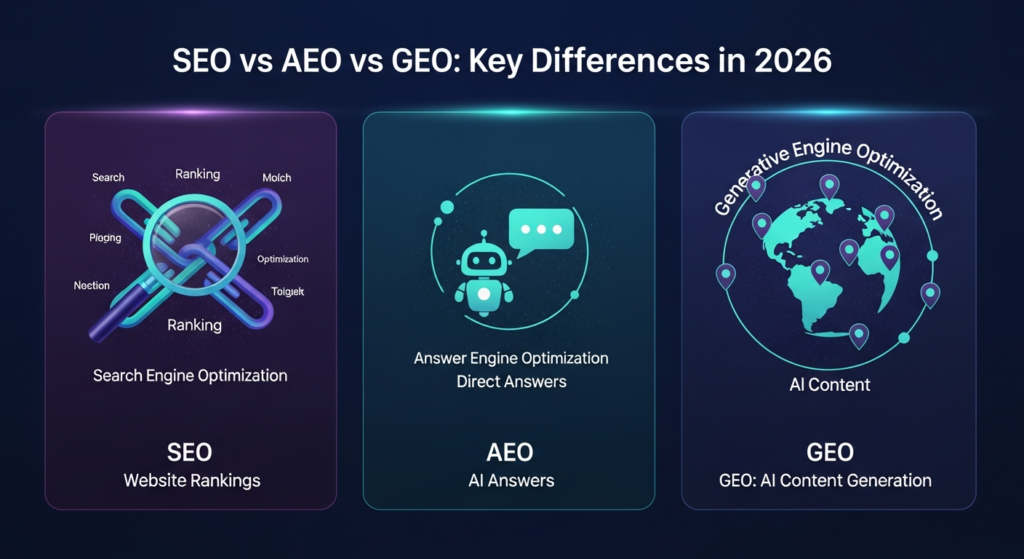
This shift means websites need stronger EEAT, entity SEO, topical authority, and conversational content strategies. Businesses that understand the difference between SEO vs. AEO vs. GEO can gain better rankings, more AI visibility, and higher trust signals.
What are SEO, AEO, and GEO?
What is SEO?
SEO (Search Engine Optimization) improves a website’s visibility in traditional search engine results.
Core SEO Activities:
- Keyword optimization
- Technical SEO
- Internal linking
- Content optimization
- Backlink building
- Mobile optimization
- Page speed improvements
What is AEO?
AEO (Answer Engine Optimization) focuses on helping search engines and AI assistants provide direct answers to users.
It targets:
- Featured Snippets
- Google AI Overviews
- Voice search
- People Also Ask
- Smart assistants
AEO focuses on:
- Question-based content
- Clear answers
- Structured data
- Conversational language
- FAQ optimization
What is GEO?
GEO (Generative Engine Optimization) helps content appear in AI-generated responses from systems such as these.
- ChatGPT
- Gemini
- Copilot
- Perplexity
- Claude
GEO focuses on:
- Entity recognition
- EEAT signals
- Topical authority
- Semantic relationships
- Unique insights
- Data-backed content
SEO vs AEO vs GEO: Main Differences
| Factor | SEO | AEO | GEO |
|---|---|---|---|
| Main Goal | Rank webpages | Provide direct answers | Get cited by AI engines |
| Focus | Keywords & rankings | Questions & answers | AI understanding |
| Platforms | Google, Bing | Voice search, AI Overviews | ChatGPT, Gemini, Perplexity |
| Content Style | Optimized articles | Concise answers | Context-rich expertise |
| Important Signals | Backlinks, UX | Structured data | Entities, EEAT |
| User Intent | Search intent | Immediate answers | Conversational AI intent |
| Success Metric | Organic traffic | Featured snippets | AI mentions & citations |
Why is knowing the difference important in 2026?
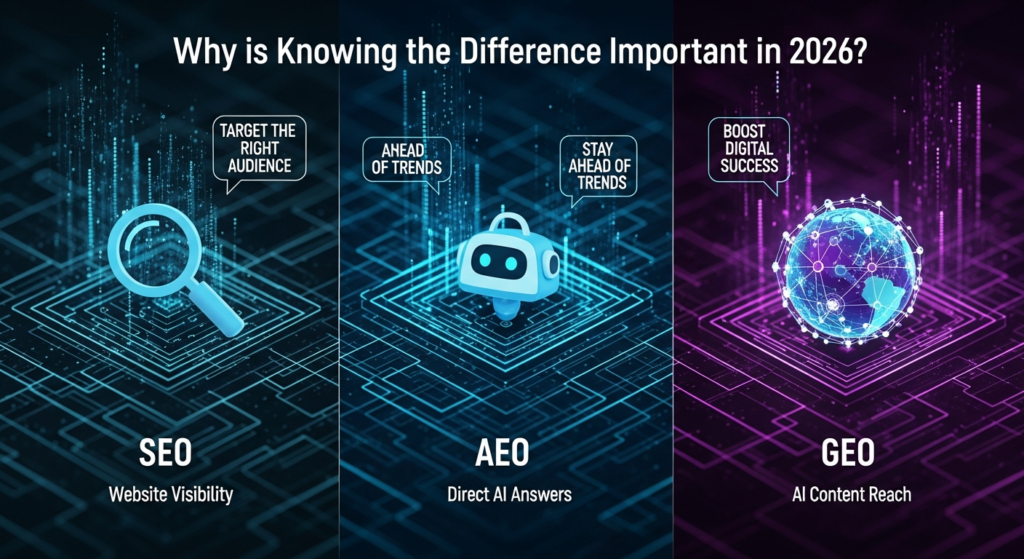
Because modern search journeys now happen across:
- Search engines
- AI assistants
- Voice assistants
- AI-generated summaries
Users often get answers without clicking websites.
- Search on Google
- Read AI Overview
- Ask ChatGPT for recommendations
- Use voice search on mobile
Why this matters:
- AI search reduces traditional clicks
- Voice search continues growing
- AI assistants prioritize trusted entities
- EEAT signals influence visibility
- Conversational queries are increasing
How do Google’s latest updates affect us? SEO vs. AEO vs. GEO?
Several Google updates now directly impact SEO, AEO, and GEO strategies.
1. Google AI Overviews
Google now generates AI summaries directly in search results.
Optimization Tips:
- Answer questions clearly
- Use short paragraphs
- Add statistics and examples
- Build topical authority
- Use schema markup
2. Helpful Content System
Google rewards people-first content instead of keyword-stuffed pages.
Best Practices:
- Write for humans first
- Add real expertise
- Avoid AI-generated fluff
- Include original insights
- Demonstrate experience
3. EEAT Improvements
EEAT stands for:
- Experience
- Expertise
- Authoritativeness
- Trustworthiness
EEAT Signals:
- Author bios
- Expert citations
- Real case studies
- Transparent sources
- Accurate information
4. Entity SEO Growth •
Google increasingly understands entities instead of just keywords.
Google connects:
- Brands
- Authors
- Topics
- Locations
- Products
Optimization Tips:
- Build entity relationships
- Use structured data
- Maintain topic consistency
- Create semantic content clusters
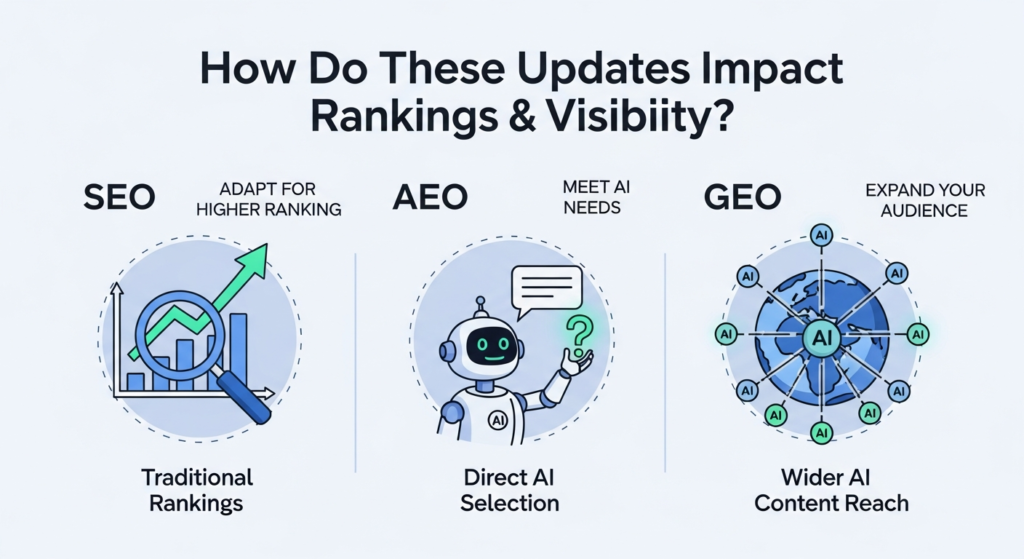
How do these updates impact rankings and visibility?
No. Traditional SEO alone is no longer enough in 2026.
Websites must optimize for:
- Rankings
- Direct answers
- AI-generated citations
What happens if you ignore AEO and GEO?
- Lower visibility in AI Overviews
- Fewer featured snippets
- Reduced voice search presence
- Fewer AI citations
- Declining organic clicks
What should businesses do now?
SEO Checklist
- Improve Core Web Vitals
- Build high-quality backlinks
- Optimize internal links
- Target search intent
- Create topic clusters
- Improve mobile UX
AEO Checklist
- Use FAQ schema
- Answer questions directly
- Add concise summaries
- Optimize for featured snippets
- Structure headings clearly
- Use conversational language
GEO Checklist
- Build topical authority
- Strengthen entity SEO
- Publish expert-led content
- Add original research
- Create trusted author profiles
- Use semantic SEO strategies
What are the biggest mistakes to avoid?
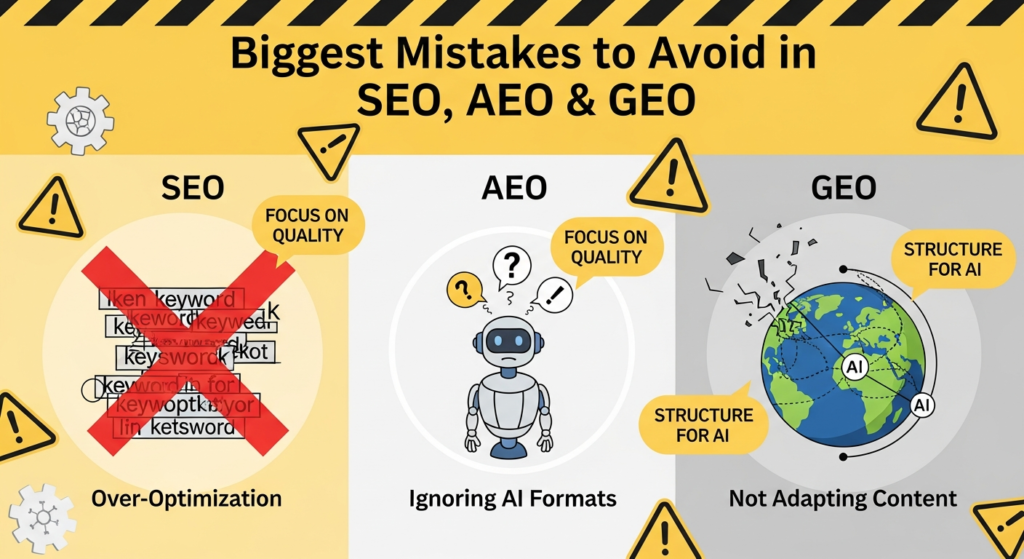
Common Mistakes Checklist
- Keyword stuffing
- Ignoring user intent
- Thin AI-generated content
- Missing schema markup
- Weak EEAT signals
- No author credibility
- Poor mobile experience
- Ignoring voice search
- Publishing duplicate content
- Lack of topical authority
Real-World Example
What does a successful SEO + AEO + GEO strategy look like
Before optimization:
A SaaS company focused only on keywords.
Results:
- Low AI visibility
- Few featured snippets
- Weak engagement
- Declining traffic
After Multi-Approach Optimization:
The company:
- Added FAQ schema
- Improved EEAT
- Built topical clusters
- Used entity-based SEO
- Published expert insights
- Optimized conversational queries
Results After 6 Months:
- Higher AI Overview visibility
- More featured snippets
- Increased brand mentions in AI tools
- Better conversion rates
- Improved organic traffic quality
Expert Tips
What are the best SEO vs. AEO vs. GEO strategies for 2026?
- Focus on user intent before keywords.
- Create content around entities and topics.
- Use concise answers near the top of pages.
- Add FAQ schema to important pages.
- Build author credibility and EEAT signals.
- Publish original insights and research.
- Optimize for conversational searches.
- Improve internal linking structures.
- Use semantic SEO instead of keyword repetition.
- Update outdated content regularly.
Key Takeaways
- SEO alone is no longer enough in 2026.
- AEO helps content appear as direct answers.
- GEO improves visibility inside AI-generated responses.
- EEAT and entity SEO are now critical ranking signals.
- Topical authority improves trust and AI citations.
- Voice search optimization continues growing.
- AI-friendly formatting increases visibility.
Conclusion
The future of digital visibility now depends on SEO, AEO, and GEO working together.
Traditional rankings still matter. However, AI assistants, AI Overviews, and generative search engines increasingly shape how users discover information.
Businesses that focus on:
- EEAT
- Entity SEO
- Topical authority
- Conversational optimization
- AI-friendly content structures
will gain stronger visibility across both traditional and AI-powered search ecosystems.
In 2026, success belongs to brands that optimize for humans, search engines, and AI systems simultaneously.